Social gaming · Playtika
Better UX was not better screens. It was how six designers decide.
A 13-year-old live game played by millions. If every call waits for the lead, the team cannot keep up with a roadmap that never stops moving. Publisher NDA: production visuals not shown.
- Problem
- Quality rose and fell with whoever was in the room, on a live game that ships to millions in parallel.
- Approach
- I asked for the Team Lead role and built the system, not the screens: one decision loop, proved on my own feature, then scaled.
- Result
- The team now owns both core hubs, the Lobby and the BCS, and its designers grew into new roles.
One live game. Six designers. One way to decide.
- 6Designers led
- 13Years live, played by millions
- 60%Players mis-clicking BCS collapse
- 2025First annual UX workshop
The stakes
If the work waits for my review, the product waits with it.
Quality rose and fell with whoever was in the room. On Bingo Blitz that is a product risk, not a coaching preference. Gameplay, retention, monetization, events, progression, and social systems all ship in parallel, on a roadmap that changes constantly, to millions of active players. One strong designer improves one feature. If the rest of the work still waits for my review, the product waits with it.
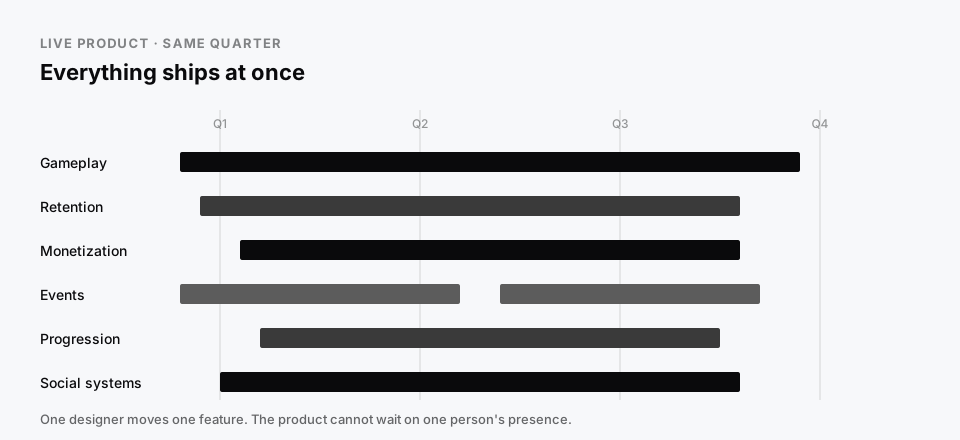
Everything ships at once. One designer moves one feature. The product cannot wait on one person's presence.
The key decision
Build the system, not the screens.
How the role was framed
The UX Team Lead does feature-by-feature UX. Better screens, tighter flows, and quality that rises or falls with whoever is in the room.
The reframe
Treat the role as product infrastructure. Shared process, a common design language, and decisions the whole team can make without me. Quality becomes a property of the system.
I asked the Director of Product for the Team Lead role. I did not wait for the scope to be handed down. I did not want a team that produced good work when I reviewed it. I wanted a team that made good decisions when I was not in the room.
The method was the same one I use on a feature. A workflow is a design process. Explore what is failing, prototype the fix on real work, refine it with the people who will use it, then take it to product leadership. Manage by running that loop on how we work, not only on what we ship.
Early as a lead I leaned on heavy specs and review gates. That made the team wait for me. I shifted toward trusting the system and the people, because the screens were never going to scale. The judgment had to.
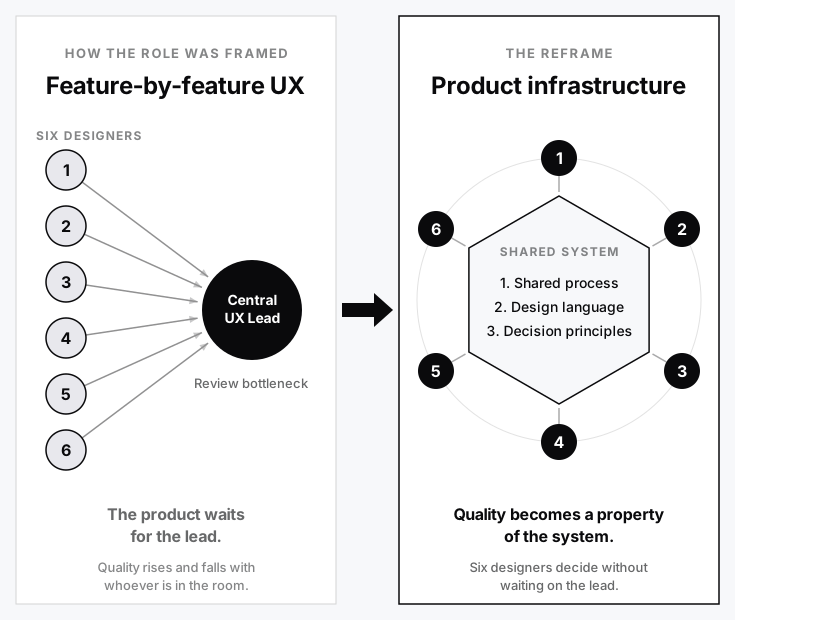
The reframe. Without a system, quality rises and falls with one person. With a system, quality becomes a property of how the team works.
What I did
One loop, proved on real work, then scaled across the team.
Explore, prototype, refine with the people closest to the work, then take it to product leadership. The same loop that designs a feature is the loop that designs how the team works.
I started with a feature I had designed myself, the card switcher. I used it to work out the Pre-Concept presentation: the business need and the player need as one question, the full flow, the risks, the open questions. I shared it with the team first, refined it on their feedback, and only then took it to my manager and my product counterpart. It became the clear flow the whole team presents to management for every feature. I did not hand a process down. I proved it on my own work, with the team in the loop, then with product.
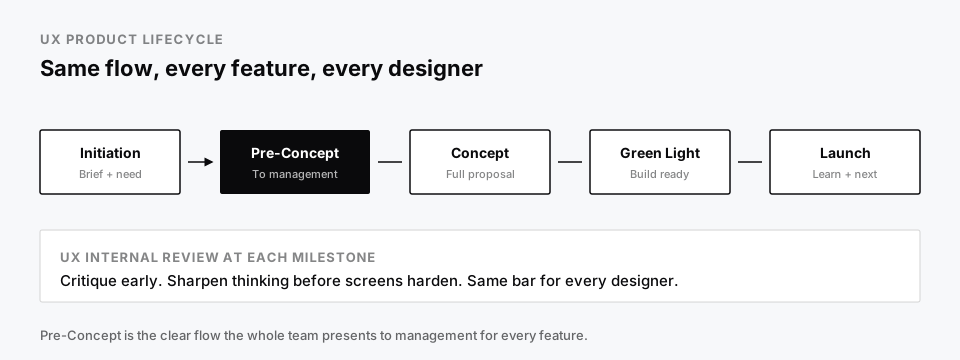
The system. Every feature, every designer, same workflow. Six designers deciding at each milestone without waiting for approval.
The same loop built the dual roadmap. Product and UX sit beside each designer's craft and career on the same quarterly cadence, because growth that is not planned does not happen.
In 2025 I ran the first annual UX department workshop the way I would run a feature workshop: reflect, share, cluster, converge. The vision went to the Director of Product only after the team owned it. That workshop is now a yearly rhythm. I will run the next one in 2026.
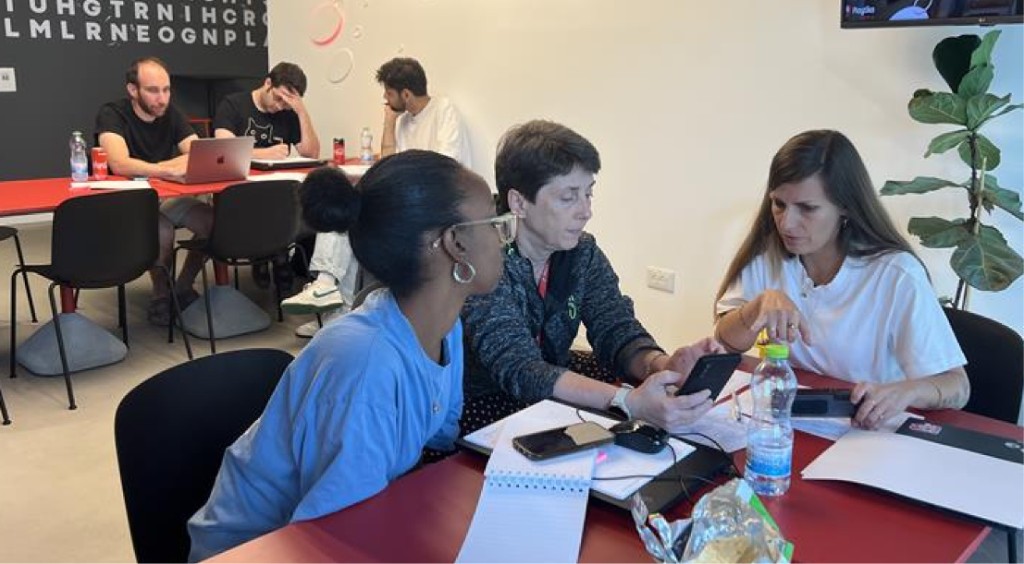
The loop, run on the team. The same design process I use on a feature, turned on how the team works.
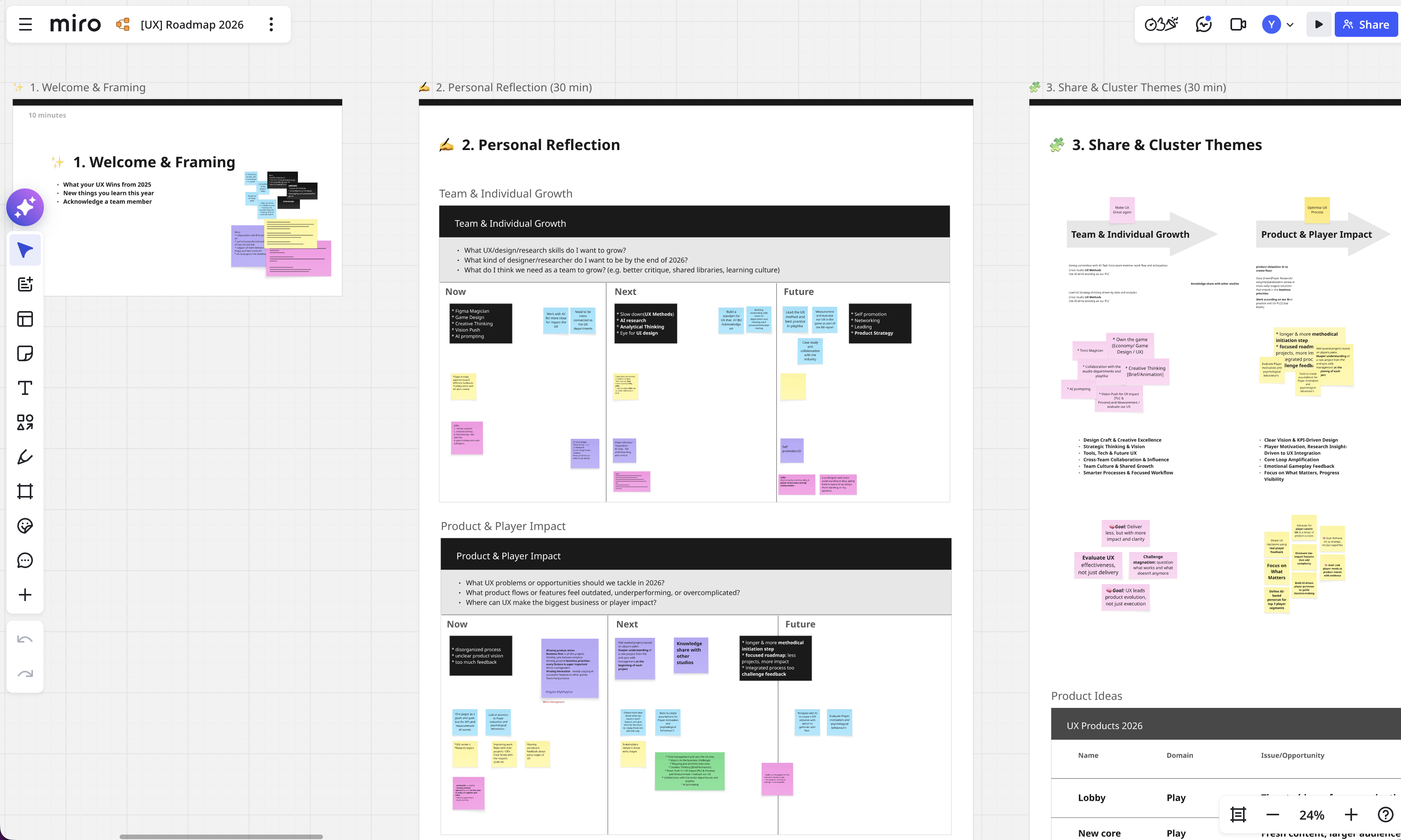
Workshop as method, not top-down decree. Reflect, share, cluster, converge. Five directions came from the team, owned by the team.
The same loop produced our design system. First we rebuilt the entire system in Figma. Then we used Figma's MCP inside Claude Code to build it as a dynamic document in code, connected to a GitHub repo. The UX Bible stopped being a reference deck. It became a coded system that our developers and product partners now build from too.
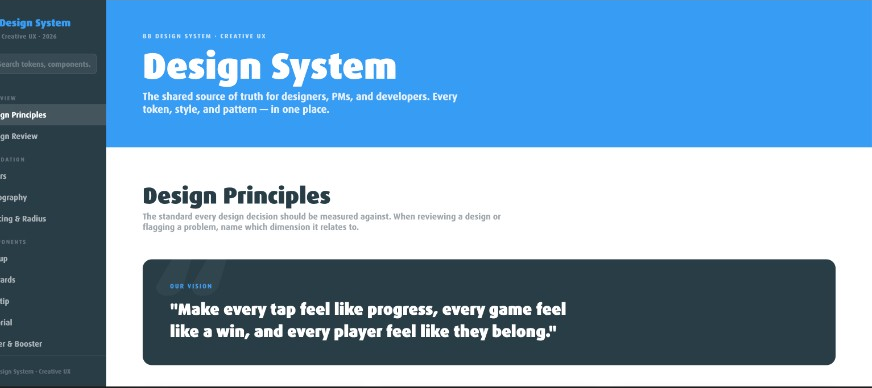
The system became code. Figma, Claude Code, and GitHub. No longer a reference deck. A live shared document that developers and product partners build from too.
Critique became an early design step, not a gate at the end, so thinking sharpened before screens hardened. AI agents entered the daily work with one bar: the tool has to make the team's judgment faster, not replace it.
By 2026 other departments started pulling on the team more. That is an external signal that the system's reach had moved past UX.
In progress
The team's decisions now reach the surfaces that matter most.
The team now owns both of the game's core hubs, the Lobby and the BCS. Both are being rebuilt to carry more of what the business needs while cutting the friction that years of stacked features created. Game data put a number on one of those frictions: 60% of players were mis-clicking the BCS collapse buttons meant for more details.
The BCS rebuild also shows which way the pull runs now. It started as a BCS project workshop we ran in late 2025. By Q1 2026 product was working on it. The order is the point: UX opened the problem, and the product organization built on it. This work is in progress, not launched, so there is no result to claim yet. What it proves is different. UX now sets the agenda on the surfaces that matter most, and the rest of the product organization builds behind it.
Work in progress, not shipped. The 60% figure is game data on BCS collapse taps, not an outcome.
Outcome
The result is not a screen. It is a team.
The clearest result is where the people went. Adam grew into a Senior UX/UI Designer on the team. Gal moved across from Marketing into a UX role, and Rom came up from an internal student into one. Angela moved to another Playtika studio through internal mobility, and Tamar left for a company where she could push her craft further. Three student interns learned the work alongside the team. Growth here is not one promotion headline. It is a group of people who each moved forward.
The first UX department workshop in 2025 is the clearest test of whether any of this holds. We left with five directions: lead instead of support, put players at the center, simplify instead of stack, grow the craft, and build better UX infrastructure. Since then, each one has moved forward. Pre-Concept and ownership of the two core hubs moved UX earlier into decisions. Lobby research and BCS data put player behavior into the brief. The hub rebuilds addressed years of stacked friction. The dual roadmap, critique, and career moves grew the team. The coded design system gave Development and Product shared infrastructure. The vision did not stay in the deck.
The team now runs concurrent product tracks from shared standards, and design enters product conversations early, with the business need and the user need treated as one problem, not two. On my three-year anniversary, our Executive General Manager put it plainly, and unprompted.
"The team, under your tenure, made a real leap forward: in their professionalism, in their presence in the studio, and in their influence on the product."
Lior Itzhak, Executive General Manager, PlaytikaReflection
What this changed about how I work.
I used to measure my contribution by what I shipped. Now I measure it by what keeps running without me.
At this scale, the lead's most important design tool is not a screen. It is the system that decides what gets built when you are not in the room. That is why the templates, the dual roadmap, and the critique rhythm exist: so six designers can make the call without waiting for me.
A workflow is a design process. Explore, prototype, refine, and repeat with the people closest to the work. That loop is how I manage, and it is how the team keeps moving when I am not there.