No design system
Every screen re-solved the same problems. Inconsistency was constant and development slowed.
Case study
Designing two drone platforms from beta — and winning the case for a design system.
Context
My role
Product Design Lead · Design System · Team Lead · QA
Company
Airobotics
Team size
1–2 designers directed by Yaniv
Products
PRIMUS (mission control) · Insightful (data analytics)
Timeline
3 years
Segment
Industrial automation & drone operations
Platforms
Windows desktop · Tablet · Browser · Mobile (5-inch)
Tools
Adobe XD, Material Design
Problem
Airobotics builds fully automated industrial drones for oil refineries and chemical plants. When I joined, both platforms were rough Photoshop prototypes — inconsistent, unscalable, and disconnected from how the product actually behaved.
Every screen re-solved the same problems. Inconsistency was constant and development slowed.
FTS terminates a drone mid-flight over an active facility — every pixel carries operational consequences.
One experience had to work on desktop, tablet, browser, and 5-inch mobile — for operators in four countries.
My role & leadership
What I owned
End-to-end design: research, IA, UX across all breakpoints, UI, design system, and QA on live builds — while directing 1–2 designers for consistency.
The pivotal conversation
Won the case for a design system against pushback from the Head of Software — reframed as an engineering accelerator (fewer loops, faster completion, lower long-term cost). The skeptic became the clearest beneficiary.
Process
01
Immersion
Two weeks on vocabulary, regulations, and operator contexts across four countries before touching pixels.
02
Information architecture
After six sprints, navigation + flight-critical controls locked in a persistent zone on every breakpoint.
03
Platform design
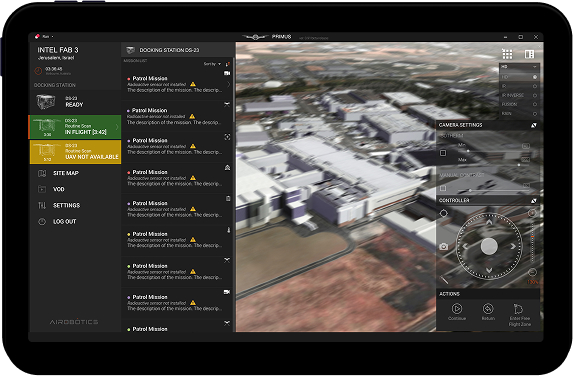
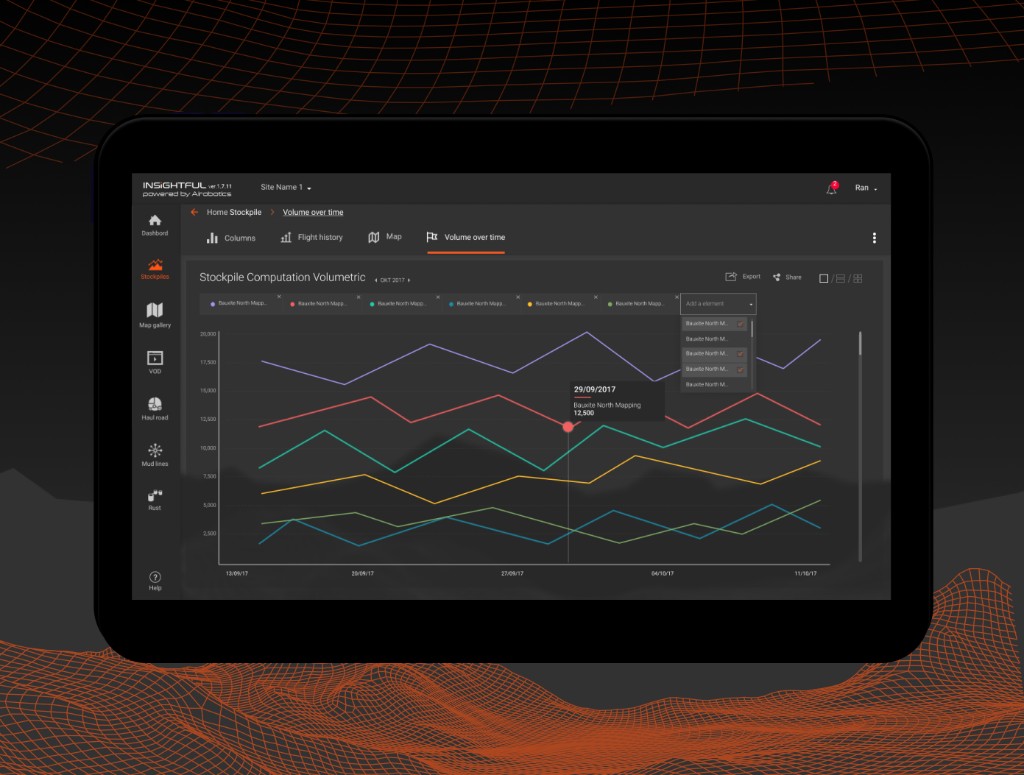
PRIMUS: status, missions, map. Insightful: weekly summaries, donuts, and multi-range performance reads.
04
Design system
Material foundation adapted for Airobotics; Photoshop retired for live Adobe XD components.
05
QA
Every sprint looped design → dev → test → revise with issues cleared before the next kickoff.
Key design decisions
Chosen: Material-based system in Adobe XD — live components tuned to drone operations.
Engineering terms won the room: fewer debates, faster shipping, measurable lift in dev velocity.
Chosen: Three dedicated flows — FTS, emergency landing, parachute — each with distinct confirmation logic.
Irreversible commands over industrial airspace demand deliberation, not generic patterns.
Chosen: Flight-critical controls always visible; secondary telemetry contextual.
Live missions leave no time to hunt — one gesture from any state for the actions that matter.
Visuals
Outcomes
2
Platforms shipped
PRIMUS + Insightful.
3
Years embedded
Full agile, sprint to sprint.
4
Countries deployed
IL · CL · AU · USA.
2022
Acquired by ONDAS
Platform scaled to public safety + FAA certification.
PRIMUS shipped as a Windows desktop mission control application; Insightful shipped as a web analytics platform — both speaking one design language. Safety-critical emergency flows were implemented with distinct confirmations. Velocity increased as the system matured, and the acquisition by ONDAS Holdings in 2022 built on the same operational foundation as the company expanded into public safety and FAA airworthiness work.
Reflection
“Design leadership means making the case before you can do the work.” Losing the design system debate would have meant compounding interface debt — the same way bad code compounds.
“Safety-critical design is a different discipline.” Every confirmation dialog, placement decision, and visual weight choice demands a level of care consumer patterns can’t assume.
“Push for field observation earlier.” Next time I’d watch a live mission sooner — many edge cases only revealed themselves deep in delivery.